Background
Reciprocal determinism is the theory set forth by psychologist Albert Bandura which states that a person's behavior both influences and is influenced by cognitive, or personal, factors and the situational factors, or social environment. Bandura accepted the possibility that an individual's behavior may be conditioned through the use of consequences, as behaviorists have maintained. At the same time, however, he asserts that a person's behavior (and personal factors, such as cognitive skills or attitudes) can impact the environment or the situational factors. In other words, social learning is not quite as simple as behaviorists before him had argued. It is a complex interplay of cognition, behavior and situation.
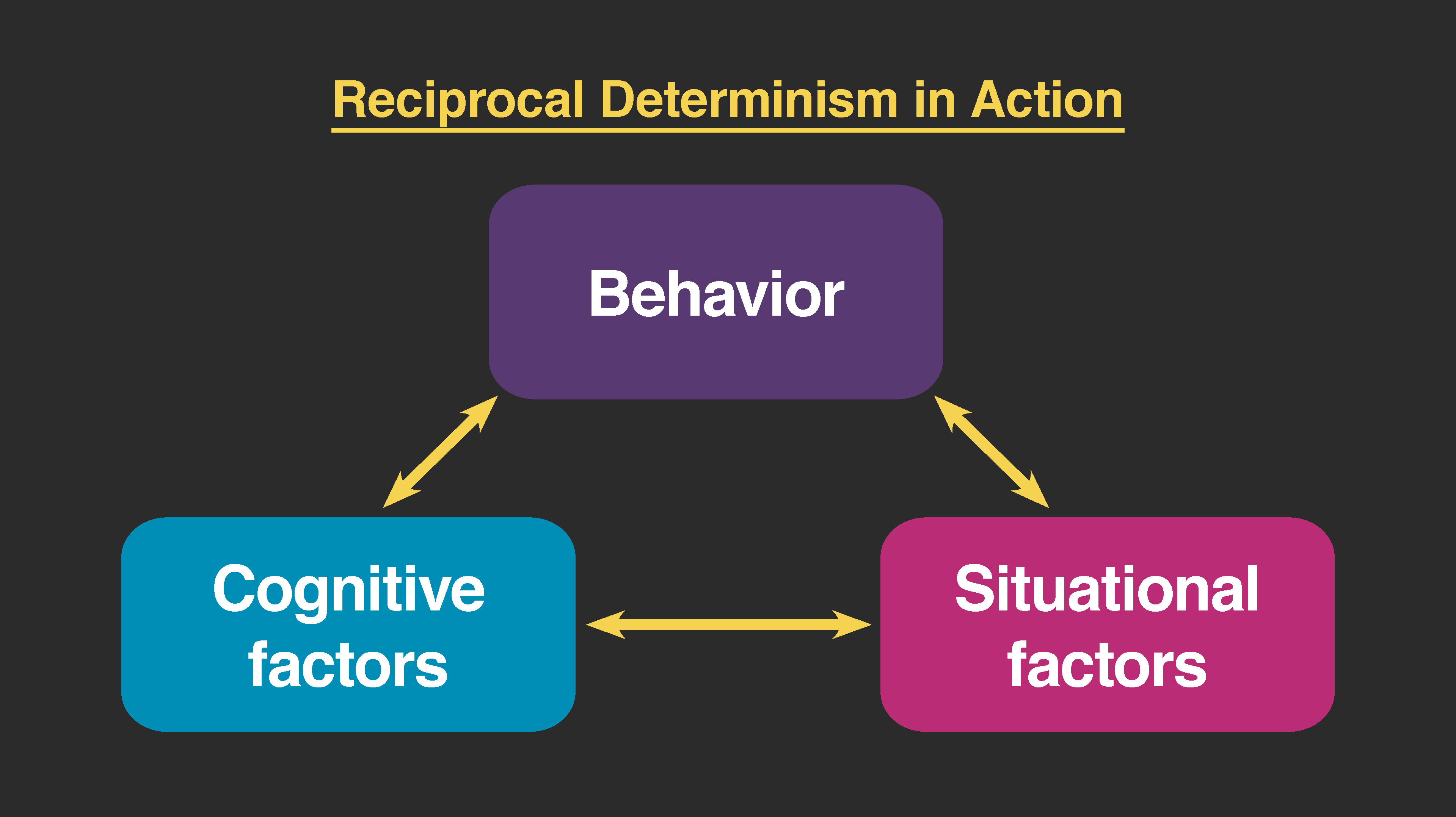
Here is an example: A child does not like school — a cognitive factor — so he acts out in school — a behavior. This result is his teacher disliking having the child around — cognitive factors — and he may yell at the child or create a special timeout environment for this child at the school — situational factors. Each behavioral and situational factor coincides with the cognitive factors of the child’s attitudes and the teacher’s dislike of the child, and so forth resulting in a continuous battle on all three levels. According to Bandura, it is not just the bad behavior of the child and the punishment of the timeout that is in play, as the behavior determinists would have it, it is a much larger interplay of factors, which he called reciprocal determinism.
As you can see in this example, the simple behavior deterministic solution of timing out the child for bad behavior may not work because of all of the other factors in play. Here is a narrative analysis of reciprocal determinism that shows how things can spiral out of control and get worse.
-
Behavior influenced by cognition and situation
- Behavior = Child acts out.
- Cognition = Child does not like school.
- Situation = Teacher yells at child or times him out a lot, making other children in the class tense.
-
Situation influenced by behavior and cognition
- Situation = Teacher yells at child or times him out a lot; classroom becomes more tense.
- Cognition = Child dislikes school more; teacher dislikes child for “making” her do harsh things; other children come to dislike the child a lot for disrupting the class.
- Behavior = Child acts out even more; teacher is angry around the child all of the time; other children begin to taunt and treat the acting out child very badly on the playground.
-
Cognitive factors influenced by behavior and situation
- Cognition = Child aware that the teacher and other children really dislike him a lot and hates the school even more
- Situation = Child notices that he is less likely to get in trouble and timed out if his acting out behaviors happen at the end ot the class periods or at the end of the day when the teacher just wants to go to the teachers’ lunchroom or go home and not have to monitor a timeout.
- Behavior = Acting out child picks and chooses the time and classmate victims (those who are more timid) for his acting out behavior and continues acting out to a higher and more manipulative and devious level.