Why is Scientific Research Important?
Note to students: The best preparation for taking the reading quiz is to pay close attention to the key terms as you read. Each question in the question banks is directly linked to these key terms and phrases.
Chapter Focus Question:
Why is scientific research significant to society, and why should psychologists continue to pursue their studies regarding human behavior?
- Hypothetico-deductive model
- Karl Popper
- Scientific method
- Hypothesis
- Theory
- Value of scientific research
- Scientific process
- Case study
Section Focus Question:
What is the process of scientific inquiry followed by today’s psychology, and how do scientists prove or disprove their hypotheses?
Key Terms:
While behavior is observable, the mind is not. If someone is behaving in a certain way, we can observe it. However, the reason for the behavior is more difficult to determine. One can simply ask — why are you behaving in this way? But people may not be comfortable or willing to answer the question honestly, or are incapable of answering because they do not understand the reason themselves. This chapter explores how scientific knowledge about the mind is generated, and how important scientific knowledge about the workings of the mind are for society.
The Process of Scientific Research
Since the time of the ancient Greeks 2,500 years ago, the scientific method has evolved in several stages to become what we use now. Today, most scientists base their discovery processes on a hypothetico-deductive model that Karl Popper first proposed in 1935. Based on their prior knowledge and experiences, scientists propose theories about the world. These theories are descriptions of the way things might be working. A theory may be unproven for some time, but scientists make good use of it by testing aspects of the theory. How do scientists test the theory? They generate expectations or hypotheses — more specific statements that lend themselves to experimental design. Each experiment is subject to rigorous standards of design and practice. Each one must also meet very high statistical demonstrations of proof before it will be accepted by other scientists. Moreover, it usually requires dozens, if not hundreds, of successful experiments that, when brought together, will prove a theory. In short, the scientific process is a tough journey with a high bar for success, as it should be.
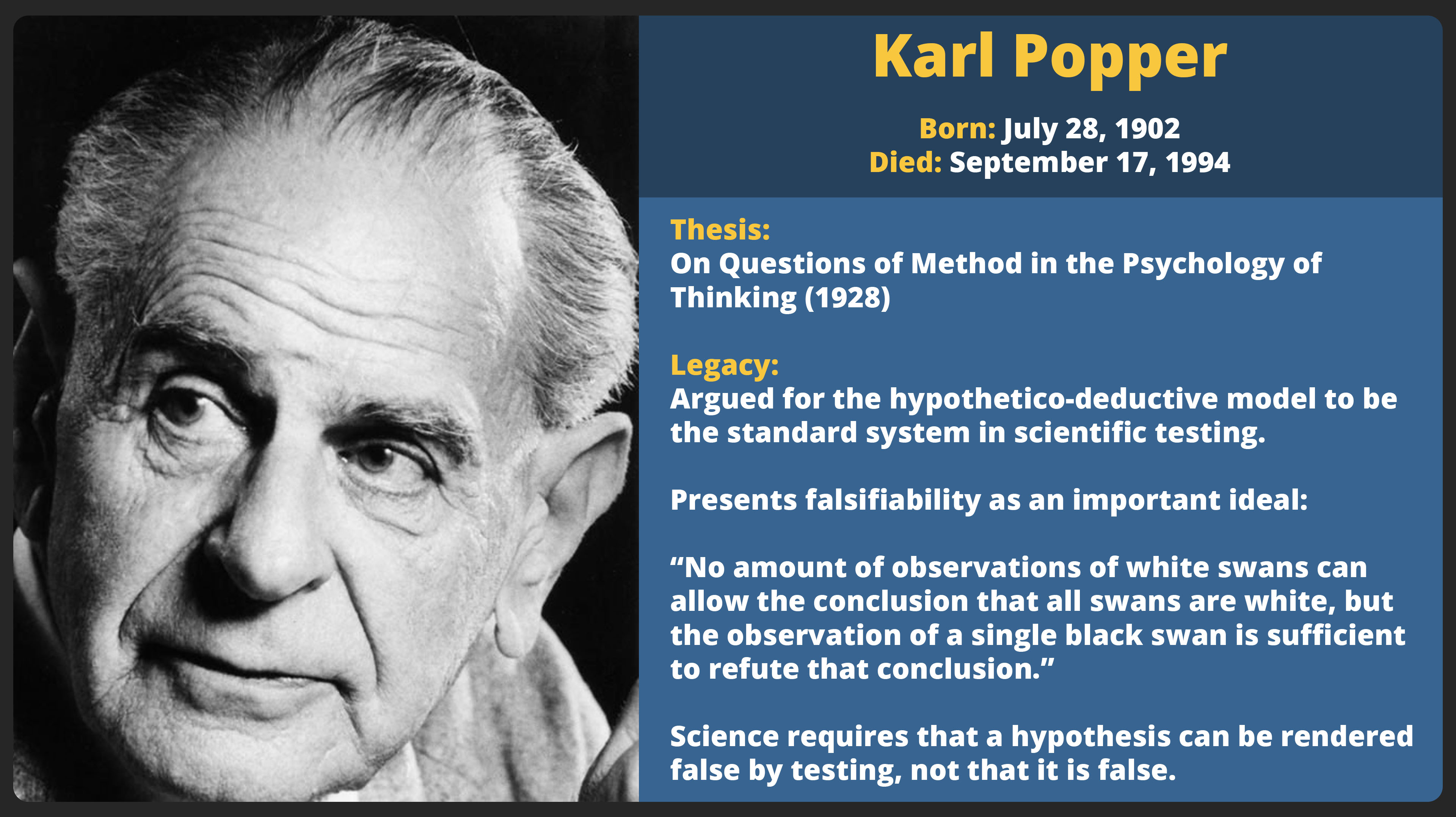
It is important to understand the difference between a theory and a hypothesis. Both are ideas, but different sorts of ideas. A theory is a well-developed set of ideas that proposes an explanation for observed phenomena. Theories are repeatedly checked against the world, but they tend to be too complex to be tested all at once. Instead, researchers create hypotheses derived from the theory. A hypothesis is a testable prediction; it is often worded as an if-then statement. For instance, if I wear a good quality sunscreen, I will not get a sunburn. The hypothesis is extremely important because it bridges the gap between the realm of ideas and the real world. As specific hypotheses are tested, theories are modified and refined to reflect and incorporate the result of these tests.
Not only is it important to understand the distinction between theory and hypothesis, one must also understand the interaction between the two in the scientific process. Again, let us look at Karl Popper’s general proposal for a deductive scientific process — from theory we derive hypotheses; with a hypothesis we design an experiment. It looks like a simple linear process, but this only tells half the story about the manner in which the scientific method is practiced. And in fact, Popper understood that the scientific method is actually circular. For when the empirical observation or experiment is run, it generates further questions that lead to new hypotheses and theories. These often adjust the way scientists think about the theory in the first place. In other words, the experiments generate a new form of reasoning that is going from the specific to the general or bottom-up, which we call inductive reasoning. Thus, the scientific method actually depends on both deductive and inductive thinking.
Does the scientific method dictate only one way of doing research in psychology? Not necessarily; it depends on the subject of research. In the next chapter, we will discuss several approaches to scientific research in psychology, from the case study to the controlled lab experiment. Each of these approaches tends to emphasize a different aspect of the circular model of scientific method. For example, a case study based on in-depth interviews with a group of 50 people convicted of pedophilia, and conducted over a 20-year period must, in order to determine life habits and patterns that may or may not contribute to further child abuse behaviors, be heavily weighted on the side of empirical observations. Thus, case studies are closely associated with inductive processes as researchers gather massive amounts of observations and seek interesting patterns (new ideas) in the data. On the other hand, a controlled lab experiment on 1,000 randomly sampled subjects that uses brain imaging to examine the effects on certain parts of the brain that we know control certain emotional impulses, puts great emphasis on a top-down, deductive reasoning process. In psychological science, both approaches are accepted because they are both suitable to the hypothesis being tested.
The Credibility of Psychological Science
- Published results
- Scientific critique
- Consensus-building process
- American Psychological Association
- Professional associations
- Pseudo-psychology
- Scientific validity
- Social ramifications of disciplinary standards
- Clinical psychology
Section Focus Question:
How do psychologists present their findings to their profession and the public, and what steps does the profession take to verify these results?
Key Terms:
Psychologists are not alone in making determinations about scientific knowledge in their discipline. When scientists design and implement an experiment or study, they publish the results. While other scientists learn about the experiment, they are expected to critique the study and probe its weaknesses. Some may also attempt to replicate it in their own research to determine if the conclusions are sound. Either way, the simple publication of a study does not mean its conclusions are accepted. Only with time, replication of results, and adjustments of the study will the scientific community come to accept the conclusions.
The process of gradual acceptance is played out in the scientific associations and journals of the discipline. Scientists attend conferences and debate theoretical knowledge in what is called “building a consensus.” It takes a long time for this consensus to build and a theory to become so widely accepted that it can be regarded as a scientific law. The associations that govern these processes in psychology include a number of general and specific groups: American Psychological Association, American Psychiatric Association, Association for Psychological Science, Society for Experimental Social Psychology, Society for Personality and Social Psychology, International Society for Self and Identity, International Association for Applied Psychology, and so on.

There is an important difference between the claims made and supported in the conferences and publications of these associations and the kind of pseudo-psychology one reads frequently on the internet. (Pseudo means to have the appearance of something but to lack its reality. It is not authentic.) A number of false assertions about human behavior can be readily found on social media to support one opinion or position or another. But the work of disciplinary associations affirms evidence that is collected and analyzed properly to pass the high bars of scientific reliability and validity. Scientific reliability means that many other scientists can repeat the study or experiment and get the same result. Scientific validity means the study actually tests the relationship it claims to test and not some other relationship. In effect, if the study has followed carefully all of the controls and practices of the scientific method and comes up with a significant result, it can be said to be valid. Consensus about a theory or hypothesis can only be reached after it has demonstrated both reliability and validity.
Not only does the psychological discipline require these high standards of credibility for itself, other groups and professionals depend on the discipline’s ability to “police” itself. For example, the federal agencies responsible for drug enforcement need psychological studies that explain the problems of addiction in order to create sound policies to reduce drug abuse. The legal agencies at both the federal and state levels need to understand the long-term psychological damage caused by sexual abuse of children to determine how to prosecute and incarcerate pedophiles. Agencies that predict catastrophic weather events need to understand human psychology in moments of crisis in order to advise local governments how and where to evacuate people in an emergency. Advertisers for corporations who want to launch a campaign to sell a new product need to understand how to appeal to the needs and wants of potential customers. This ultimately determines the success and value of the company. All of these agencies and entities depend on psychologists to provide accurate, scientific information. In fact, agencies will often commission studies from psychologists and their universities to make sure they have the most specific and accurate conclusions they can get.
Ethics in Experimentation
- Ethics
- Psychological studies
- Informed consent
- Institutional review board (IRB)
- Deception
- Human subjects
- Non-human subjects
- Institutional Animal Care and Use Committee
Section Focus Question:
What steps have been taken to assure that psychological experiments are conducted in an ethical manner, and why has this become an important issue?
Key Terms:
But significance, reliability, and validity are not the only concerns of psychologists. All agree that good research is ethical in nature and is guided by a basic respect for human dignity and safety. Unfortunately, some experimentation on human subjects in the past has not been acceptable. The psychology profession today is governed by clear standards of ethical conduct in research and experimentation.